1. What Factors Determine the Required Capacity of a Stainless Steel Water Tank?
1.1 Building Type
Different types of buildings have different water consumption patterns. Residential buildings mainly require domestic water, while hotels and commercial buildings may experience higher and more concentrated water demand.
1.2 Number of Occupants
The number of occupants is one of the key factors in estimating domestic water consumption. For residential buildings, the actual number of residents should be considered, while office buildings and public facilities should account for employees and visitors.
1.3 Water Supply System
The required tank capacity also depends on the water supply arrangement, such as direct municipal water supply, a low-level tank with a booster pump, or a high-level water tank. A more stable water supply generally reduces the need for excessive storage capacity.
1.4 Water Supply Reliability
Buildings that require a continuous water supply may need additional storage to cope with temporary interruptions or insufficient supply pressure. Hospitals, hotels, and important public facilities usually require greater attention to water supply reliability.
2. How Can Daily Water Consumption Be Calculated Based on the Number of Occupants?
2.1 Determine the Number of Occupants
The first step is to determine the actual or design occupancy of the building. A suitable water consumption allowance should then be selected according to the building's intended use.
2.2 Determine the Daily Water Consumption per Person
The daily water consumption allowance is usually expressed in liters per person per day. Different allowances should be used for residential buildings, offices, hotels, schools, and other types of facilities.
2.3 Calculate the Daily Water Consumption
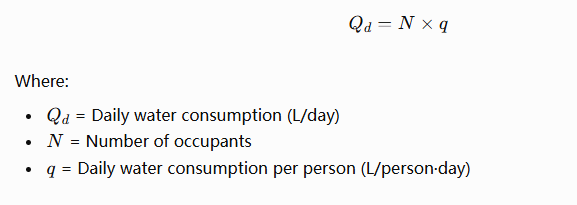
The daily water consumption can be estimated by multiplying the number of occupants by the daily water consumption allowance per person. The basic formula is:
3. How Can Tank Capacity Be Determined Based on Water Storage Duration?
3.1 Determine the Required Storage Duration
Storage duration refers to the period during which the tank can meet the building's water demand when the incoming water supply is interrupted or insufficient. It should be determined according to water supply reliability, building usage, and applicable design requirements.
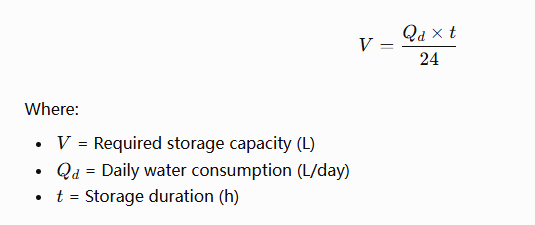
3.2 Calculate the Basic Storage Capacity
Once the daily water consumption and required storage duration have been determined, the basic storage capacity can be calculated using the following formula:
3.3 Adjust the Storage Duration According to Water Supply Conditions
If the municipal water supply is continuous and reliable, the tank may only need to provide a certain amount of buffer and short-term storage. If water supply interruptions occur frequently, the storage duration should be increased according to the actual interruption period.
3.4 Avoid Unnecessary Storage Capacity
A larger water tank is not always better. Excessive storage capacity may result in longer water retention times and make water quality management more difficult. The design should balance water supply reliability, equipment investment, and water quality requirements.
4. How Should Peak Water Demand Be Considered When Sizing a Water Tank?
4.1 Understand the Building's Water Consumption Patterns
Water demand is generally not evenly distributed throughout the day. It is often concentrated during specific periods, such as mornings, lunchtime, and evenings. The tank design should account for these periods of concentrated water consumption.
01
4.2 Consider Peak Hourly Water Consumption
For buildings with concentrated or high instantaneous water demand, peak hourly consumption should be analyzed to ensure that the tank and water supply equipment can meet actual requirements. Peak hourly water consumption can be estimated based on building type, the number of water-using fixtures, and usage patterns.
02
4.3 Design the Tank and Water Pump as a Combined System
In a water supply system equipped with a tank and pump, the tank can help balance peak water demand. When the instantaneous water demand exceeds the incoming supply flow rate, the tank provides additional water and helps reduce pressure fluctuations in the system.
03
4.4 Determine the Appropriate Buffer Capacity
The buffer capacity should be determined according to the pump operating mode, replenishment flow rate, and variations in building water demand. For buildings equipped with variable-frequency pumps or continuous replenishment systems, system analysis may help reduce the required buffer storage capacity.
.
04
Products Description
5. How Can the Effective Capacity and Actual Capacity of a Water Tank Be Calculated?
5.1 Distinguish Between Effective Capacity and Nominal Capacity
The nominal capacity refers to the tank's geometric volume, while the effective capacity refers to the amount of water that can actually be used for supply. Since water tanks generally have minimum operating levels and maximum control levels, their effective capacity is usually smaller than their nominal capacity.
5.2 Consider Unusable Space Inside the Tank
A certain amount of space may need to be reserved at the bottom of the tank for drainage, cleaning, and equipment installation. Additional space should also be provided above the maximum water level to prevent overflow and ensure proper operation.
5.3 Calculate the Geometric Volume of the Tank
For a common rectangular stainless steel water tank, the geometric volume can be calculated by multiplying its length, width, and height:
V=L×W×H
Where (L), (W), and (H) represent the internal length, internal width, and internal height of the tank, respectively. All dimensions must be expressed in consistent units.
5.4 Determine the Tank Dimensions Based on Effective Capacity
After determining the required effective storage capacity, the actual geometric volume should be calculated based on the effective water depth and internal structure. The tank should provide sufficient usable water within its normal operating water level range.
6. Should Fire Protection Water Be Included in the Required Tank Capacity?
6.1 Distinguish Domestic Water from Fire Protection Water
Domestic water and fire protection water serve different purposes and are subject to different design requirements. The required storage capacities should be determined separately according to the building's water supply system and applicable fire protection regulations.
01
6.2 Determine Fire Protection Storage Requirements
If a building requires a fire water tank or fire water reservoir, the required fire protection storage volume should be determined in accordance with applicable fire protection codes. This volume generally depends on the building type, fire hazard classification, fire protection system, and required water supply duration.
02
6.3 Determine Whether Domestic and Fire Protection Storage Can Be Combined
Some buildings may use a combined domestic and fire protection water reservoir. However, the design must ensure that the required fire protection storage volume cannot be consumed by domestic water use. The combined reservoir must comply with applicable local fire protection requirements.
03
6.4 Avoid Double-Counting Storage Capacity
When calculating the total storage capacity of a building, the storage requirements for domestic water, fire protection water, and other process water should be clearly defined. If these storage systems are independent, their capacities should be calculated separately to avoid double-counting or omitting necessary storage volume.
04
7. How Can the Appropriate Stainless Steel Water Tank Dimensions Be Selected?
7.1 Consider the Available Installation Space
The tank dimensions should be determined according to the available space in equipment rooms, basements, rooftops, or outdoor installation areas. Sufficient space should also be reserved for installation, inspection, cleaning, and pipe connections.
7.2 Consider the Structural Load Requirements
The weight of a water tank increases significantly when it is filled with water. Therefore, the load-bearing capacity of the building structure must be considered. For rooftop and elevated water tanks, qualified professionals should verify the structural loads and installation safety.
7.3 Select an Appropriate Tank Structure
Stainless steel water tanks can be designed in rectangular, cylindrical, or modular configurations. The appropriate structure should be selected according to the required capacity, installation space, and manufacturing conditions. For large-capacity tanks, modular designs can facilitate transportation, on-site installation, and future maintenance.
7.4 Consider the Material and Operating Environment
The tank material should be selected according to water quality, environmental conditions, and application requirements. Common materials include 304 and 316 stainless steel. For applications involving high chloride concentrations or more corrosive environments, material selection should be based on water analysis and corrosion resistance.
If you want to know more about heat exchanger units or are interested in purchasing, please send an email to 9988xiaoshuai@gmail.com, we will reply you in time after seeing the message!
Professional team
Our company is equipped with a high-quality after-sales service team with technical personnel as the core, and will provide timely feedback upon receiving service information notifications from users.
7x24 hours delivery
Our company provides free technical support for the products we sell and organizes technical training for relevant personnel.